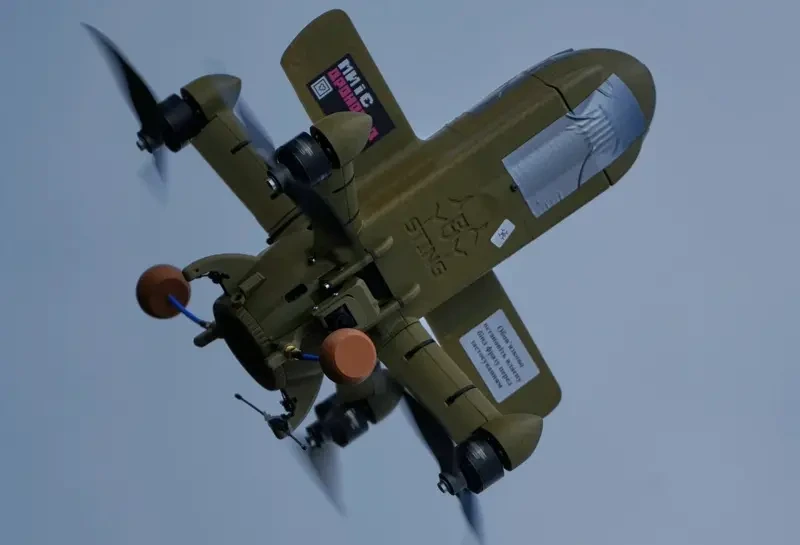
According to an Associated Press report, Ukraine—which relies heavily on drones to counter the Russian military—faces a critical vulnerability: it remains dependent on China for many electronic components. Kyiv’s primary concerns are that Beijing might impose strict export controls on these essential parts, or that Chinese factories might prioritize supplying Russia instead.
Over the past two years, Ukraine has sought to expand domestic production and increase procurement from Taiwan, Europe, and the United States, aiming to reduce its reliance on Chinese-made components such as motors and flight controllers.
However, the low cost and high production capacity of Chinese goods make them difficult for suppliers from allied nations to replace.
Oleksandr Yakovenko, from the major Ukrainian defense firm TAF Industries, stated that a complete shift to Western-made components could drive up costs by as much as 60% while potentially reducing production output by roughly the same margin.
Nevertheless, Ukrainian drone manufacturers are striving to increase the share of domestically produced components to lessen their dependence on China.
Data from Ukrainian customs indicates that the proportion of drone components imported directly from China has fallen from nearly 90% at the beginning of 2024 to 28% during the first eight months of this year.
Yet, the actual decline may be less dramatic than it appears. Some components recorded as originating from countries like Poland or the Czech Republic are likely Chinese-made goods that were merely transshipped through those nations.
Thermal imaging cameras serve as a prime example of technology that remains difficult to source outside of China. While Ukrainian companies can handle the design work, they still must import the infrared sensors and lenses. China possesses abundant supplies of germanium—a key raw material—which makes Chinese-made lenses significantly cheaper than European alternatives. Although the U.S. and Europe also produce such sensors, most of their output is consumed by their own domestic markets.
Andrii Taganskyi, an executive at the Ukrainian arms manufacturer Odd Systems, noted that Europe produces only about 600,000 infrared sensors annually—far short of the 4 million units Ukraine estimates it needs. Certain Chinese components remain indispensable; as Taganskyi put it, “Without that 5%, there are no cameras.”